Tuesday, June 15, 2010

A new opportunity for Pakistan


by: Farrukh Salim


General Stanley McChrystal, commander of NATO forces in Afghanistan has once again arrived in Pakistan to “provide an update on International Security Assistance Forces’ operations in Afghanistan,” reads the handout by the American Embassy in Islamabad. Hardly does any substantial information leak from the garrison city of Rawalpindi of the meetings by General Kiyani and his visitors, except for stories filed from Washington by the New York Times or Washington Post. In a few days the papers will report on how much General Stanley McChrystal appreciated the sacrifices of the Pakistan army but it must do more and flush out the remaining Taliban, from the epicenter of their activities which is constantly revolving and currently holed up in North Waziristan.


General McChrystal’s visit to Pakistan comes as calm winds have once again started blowing east, particularly from the presidential palace in Kabul after a very long time. When President Hamid Karzai was invited to attend Asif Ali Zardari’s inauguration two years ago many in Pakistan condemned it, rightfully as Karzai’s statements at the time were filled with venom; he once wept in a news conference alleging that Pakistan was involved in the killing of Afghanistan’s children. President Karzai’s tone though has changed since his reelection which was marred by allegations of massive rigging, particularly by his western benefactors. The people who formulate Pakistan’s foreign policy (read army) fully backed him against Abdullah Abdullah, the former foreign minister and a veteran of the Northern Alliance.


Pakistan also wasn’t shy when it came to accusations. Interior Minister Rehman Malik habitually accused Afghanistan of aiding and abetting the terrorist who were destabilizing Pakistan. The relationship between Islamabad and Kabul will only improve in the coming months following the recent two day jirga in Afghanistan. The jirga mandated President Karzai’s government to move towards a peaceful solution with Taliban elements and have their names removed from the list of wanted terrorist. The jirga was marred by a brazen but failed suicide attack, which led to the resignation (sacking) of Afghanistan’s interior minister Mohammad Hanif Atmar and intelligence chief Amrullah Saleh.


Karzai had long wanted the removal of Mr. Saleh in particular. Not only did their ideologies clash but their roadmap for peace in Afghanistan did not coincide. President Karzai has repeatedly referred to Mullah Muhammad Omar as his “brother.” In fact, during his speech at the peace jirga, Karzai spoke directly to Mullah Omar saying, “dear brother, Talib-jan, this is your country, come and have a peaceful life.” Mr. Saleh on the other hand has often equated Mullah Omar with Osama Bin Laden. Saleh, who was adored by the western security apparatus in Afghanistan, was element of Ahmed Shah Masood’s security also when he was killed by two men posing as French journalist. His talent perhaps needs to be reevaluated.
Pakistan will also welcome Mr. Saleh’s resignation, as they did not have a good relationship with Mr. Saleh while he was head of Afghanistan’s Nationial Intelligence directorate. Mr. Saleh’s post resignation interviews have revealed the nature of his views on Pakistan; clear mistrust. Pakistan must use this opportunity to rebuild their relationship with the Afghan security and intelligence agencies as both are faced with similar challenges.

Kabul, Islamabad and Washington have realized that peace in Afghanistan is linked to the integration of Taliban into the mainstream. What they now must realize is the only way to bring the Taliban into the mainstream is to give a firm and final date for withdrawal of coalition forces.

Monday, June 14, 2010

LSE: ISI Supporting Taliban; Pakistan: Report is Rubbish

Pakistan Denies Involvement With Afghan Taliban

VOA News14 June 2010

Pakistani political and military officials are denying a report that alleges the country's intelligence agency has direct links with the Afghan Taliban.

The report released Sunday by the London School of Economics said Pakistan's ISI agency not only provides funding, training and sanctuary to Taliban fighters in Afghanistan but is also represented on the movement's leadership council, known as the Quetta shura.

Pakistani military spokesman Major General Athar Abbas on Monday rejected the report as part of a "malicious" campaign against the country's military and security agencies.

Presidential spokeswoman Farahnaz Ispahani also said the accusations are false.

The London School of Economics report says Pakistani President Asif Ali Zardari and a senior ISI official allegedly visited senior Taliban prisoners held at a secret location. The two reportedly told the prisoners they were arrested only because of U.S. pressure and would be released.

The study was based on interviews with nine Taliban field commanders in Afghanistan.

Pakistan helped the Taliban rise to power in Afghanistan in the 1990s but renounced the group in response to pressure following the September 11, 2001 terrorist attacks against the United States.


Pakistan's government is now fighting Taliban militants based on its territory and this year captured the Afghan group's number-two leader, Mullah Abdul Ghani Baradar, in Karachi.

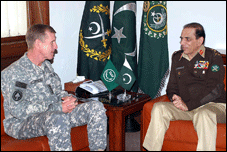
Separately Monday, the top U.S. and NATO commander in Afghanistan, General Stanley McChrystal, held talks with Pakistan's army chief, General Ashfaq Kayani, near Islamabad.

Monday, March 29, 2010

Christian Taliban?

Christian militia members charged in Michigan
DETROIT

(Reuters) - Nine members of a Christian militia group were indicted on charges of conspiring to wage war against the U.S. government, federal prosecutors said on Monday.

U.S.

According to the grand jury indictment unsealed in U.S. District Court for the Eastern District of Michigan, the eight men and one woman were members of a group called the Hutaree that planned to kill a police officer in Michigan and then ambush the law enforcement officers who attended his funeral.


The indictment said the group believed the attacks would "serve as a catalyst for a more widespread uprising" against the government.

Eight people were arrested by the FBI over the weekend in raids in Michigan, Ohio and Illinois. One of the accused, Joshua Stone, 21, is still at large.

The arrests followed a federal grand jury indictment handed down in Detroit charging them with seditious conspiracy, attempted use of weapons of mass destruction, and possessing a firearm during a crime of violence.

The weapons of mass destruction charge referred to improvised explosive devices with projectiles, the indictment said.

Seven of the eight in custody were arraigned on Monday. On Wednesday, U.S. Magistrate Donald Scheer will consider the prosecutor's request that the defendants be held without bail. The status of the eighth person was not immediately clear.

The group's website, hutaree.com, says the term Hutaree means "Christian warrior" and characterizes the group as "preparing for the end time battles to keep the testimony of Jesus Christ alive." It also features a Bible quotation from John 15:13: "Greater love hath no man than this, that a man lay down his life for his friends."

The indictment said the leader of the group is David Brian Stone Sr., 45, of Clayton, Michigan, who was among those arrested.

A woman identifying herself as Donna Stone, who said she was David Brian Stone Sr.'s ex-wife, appeared at Monday's court hearing. She told reporters that her ex-husband's increasing obsession with firearms had been the cause of the divorce.

She said: "When he got carried away from handguns to big guns, I said, 'I'm done.'"

Sunday, March 21, 2010

Congress clears historic health care bill

WASHINGTON – Summoned to success by President Barack Obama, the Democratic-controlled Congress approved historic legislation Sunday night extending health care to tens of millions of uninsured Americans and cracking down on insurance company abuses, a climactic chapter in the century-long quest for near universal coverage.
Widely viewed as dead two months ago, the Senate-passed bill cleared the House on a 219-212 vote, with Republicans unanimous in opposition.
Congressional officials said they expected Obama to sign the bill as early as Tuesday.
A second measure — making changes in the first — was lined up for passage later in the evening. It would then go to the Senate, where Democratic leaders said they had the votes to pass it.


Crowds of protesters outside the Capitol shouted "just vote no" in a futile attempt to stop the inevitable taking place inside a House packed with lawmakers and ringed with spectators in the galleries above.
Across hours of debate, House Democrats predicted the major bill, costing $940 billion over a decade, would rank with other great social legislation of recent decades.
"We will be joining those who established Social Security, Medicare and now, tonight, health care for all Americans, said Speaker Nancy Pelosi, partner to Obama and Senate Majority Leader Harry Reid, D-Nev., in the grueling campaign to pass the legislation.
"This is the civil rights act of the 21st century," added Rep. Jim Clyburn of South Carolina, the top-ranking black member of the House.
Republicans readily agreed the bill would affect everyone in America, but warned repeatedly of the burden imposed by more than $900 billion in tax increases and Medicare cuts combined.
"We have failed to listen to America," said Rep. John Boehner of Ohio, leader of a party that has vowed to carry the fight into the fall's midterm elections for control of Congress.
The nonpartisan Congressional Budget Office said the legislation would extend coverage to 32 million Americans who lack it, ban insurers from denying coverage on the basis of pre-existing medical conditions and cut deficits by an estimated $138 billion over a decade. If realized, the expansion of coverage would include 95 percent of all eligible individuals under age 65.
Far beyond the political ramifications — a concern the president repeatedly insisted he paid no mind — were the sweeping changes the bill held in store for millions of individuals, the insurance companies that would come under tougher control and the health care providers, many of whom would face higher taxes.
For the first time, most Americans would be required to purchase insurance, and face penalties if they refused. Much of the money in the bill would be devoted to subsidies to help families at incomes of up to $88,000 a year pay their premiums.
The measure would also usher in a significant expansion of Medicaid, the federal-state health care program for the poor. Coverage would be required for incomes up to 133 percent of the federal poverty level, $29,327 a year for a family of four. Childless adults would be covered for the first time, starting in 2014.
The insurance industry, which spent millions on advertising trying to block the bill, would come under new federal regulation. They would be forbidden from placing lifetime dollar limits on policies, from denying coverage to children because of pre-existing conditions and from canceling policies when a policyholder becomes ill.
Parents would be able to keep children up to age 26 on their family insurance plans, three years longer than is now the case.
A new high-risk pool would offer coverage to uninsured people with medical problems until 2014, when the coverage expansion would go into high gear.
The final obstacle to passage was cleared a few hours before the vote, when Obama and Democratic leaders reached a compromise with anti-abortion lawmakers whose rebellion had left the outcome in doubt. The president issued an executive order pledging that no federal funds would be used for elective abortion, satisfying Rep. Bart Stupak of Michigan and a handful of like-minded lawmakers.
A spokesman for the U.S. Conference of Catholic Bishops expressed skepticism that the presidential order would satisfy the church's objections.
For the president, the events capped an 18-day stretch in which he traveled to four states and lobbied more than 60 wavering lawmakers in person or by phone to secure passage of his signature domestic issue. According to some who met with him, he warned that the bill's demise could cripple his still-young presidency.
After more than a year of political combat, Democrats piled superlative upon superlative across several hours of House debate.
Rep. Louise Slaughter of New York read a message President Franklin Roosevelt sent Congress in 1939 urging lawmakers to address the needs of those without health care, and said Democrat Harry Truman and Republican Richard Nixon had also sought to broaden insurance coverage.
Republicans attacked the bill without let-up, warning it would harm the economy while mandating a government takeover of the health care system.
"The American people know you can't reduce health care costs by spending $1 trillion or raising taxes by more than one-half trillion dollars. The American people know that you cannot cut Medicare by over one-half trillion dollars without hurting seniors," said Rep. Dave Camp, R-Mich.
"And, the American people know that you can't create an entirely new government entitlement program without exploding spending and the deficit."
Obama has said often that presidents of both parties have tried without success to achieve national health insurance, beginning with Theodore Roosevelt early in the 20th century.
The 44th president's quest to succeed where others have failed seemed at a dead end two months ago, when Republicans won a special election for a Massachusetts Senate seat, and with it, the votes to prevent a final vote.
But the White House, Pelosi and Reid soon came up with a rescue plan that required the House to approve the Senate-passed measure despite opposition to many of its provisions, then have both houses pass a fix-it measure incorporating numerous changes.
To pay for the changes, the legislation includes more than $400 billion in higher taxes over a decade, roughly half of it from a new Medicare payroll tax on individuals with incomes over $200,000 and couples over $250,000. A new excise tax on high-cost insurance policies was significantly scaled back in deference to complaints from organized labor.
In addition, the bills cut more than $500 billion from planned payments to hospitals, nursing homes, hospices and other providers that treat Medicare patients. An estimated $200 billion would reduce planned subsidies to insurance companies that offer a private alternative to traditional Medicare.
The insurance industry warned that seniors would face sharply higher premiums as a result, and the Congressional Budget Office said many would return to traditional Medicare as a result.
The subsidies are higher than those for seniors on traditional Medicare, a difference that critics complain is wasteful, but insurance industry officials argue goes into expanded benefits.

Thursday, March 18, 2010

Mullah Baradar arrest: UN envoy criticizes Pakistan for arrests

Kai Eide, the UN's special representative to Afghanistan until earlier this month, has attacked Pakistan for having arrested prominent Taliban leaders who were taking part in back-channel peace talks.

Eide, a Norwegian, confirmed for the first time since leaving office that he had held what seemed to him to be promising discussions with senior Taliban representatives, but that channels of communication had shut down after the arrests.

These arrests had a "negative effect" on prospects for continuing the political process, he told the BBC World Service. The talks had taken place with at least the tacit assent of the Taliban leader, Mullah Omar, Eide believed. "I find it unthinkable that such contact would take place without his knowledge," he said.


Eide was tasked with bringing impetus to peace efforts in Afghanistan two years ago when relations between Kabul and the international community were in crisis. He left his post 10 days ago.

The US is sceptical about negotiations, though Britain wants greater efforts to talk to the Taliban about cutting ties with al-Qaida and ending a conflict which has cost more than 270 British lives and is being intensified by Kabul's inefficiency and corruption.

"Of course I met Taliban leaders during the time I was in Afghanistan," Eide said. "Anything else would have been unthinkable." He said that the first contacts were made last spring, with a lull until after the August 2009 election. But they ended a few weeks ago when US and Pakistani intelligence arrested Mullah Abdul Ghani Baradar, the number two in the Taliban command, in Karachi. Up to 14 others were also detained.

Baradar's seizure was reported as a breakthrough in co-operation between the CIA and Pakistan's Inter-Services Intelligence agency, but a key figure in back-channel talks involving Saudi Arabia described his arrest as "a huge blow" to the fledgling peace initiative.

Eide was highly critical of Pakistan and questioned its motives. "If your question had been, 'do I believe that Pakistan plays the role it should in promoting a political dialogue that is so necessary for ending the conflict in Afghanistan?' – then my answer would be no, the Pakistanis did not play the role that they should have played. They must have known about this; I don't believe that these people were arrested by coincidence. They must have known who they were, what kind of role they were playing; and you see the result today."

Eide said he believed Pakistan wanted to stop the UN and Afghan talks with the Taliban to retain control of the process.

The diplomat also took issue with senior US military and political officials, including General David Petraeus, the head of Central Command, who argue that peace talks are premature and that the Taliban will only begin to negotiate in good faith once they have felt the full force of the US-led military surge.

"I believe, on the contrary, that talks are long overdue, and had we really engaged in them some time ago then we could have progressed further than we have today," Eide said in the BBC interview.

"I think I have experienced, over 35 years of engagement in international affairs, that we very often misjudge our opponents, or the other side. We did that in the 1950s, the 1960s, the 1970s. We did it in the 1990s. And we do it again, I believe; and that, perhaps if we had seen it from the point of view of the Taliban, maybe we would have come to a different conclusion than the one we've come to today. I believe that what has happened over the last few weeks may well have hardened the Taliban, rather than moved them closer to the table."

Eide had previously argued that talks with the Taliban were the best way to end the eight-year-old war and expressed concern that Barack Obama's decision to send 30,000 to 35,000 additional US troops to Afghanistan is coming without a concurrent political surge.

Courtesy: guardian.co.uk

Thursday, January 28, 2010

Karzai wants talks with Taliban 'brothers': US, UK and Pakistan on board

LONDON — Afghanistan’s president declared Thursday that reaching out to the Taliban’s leadership would be a centerpiece of his plan to end the eight-year-old war in his country, setting in motion a risky diplomatic gambit that could aggravate frictions with the United States.

A 65-nation conference here intended to muster money and support for an Afghan war strategy instead exposed divisions between the Afghan government and its allies over the timetable for drawing down foreign forces and whether and how to reconcile with the leaders of the Taliban insurgency.


“We must reach out to all of our countrymen, especially our disenchanted brothers,” President Hamid Karzai said. In the coming weeks, he said, he will invite Taliban leaders to a tribal assembly to try to persuade them to lay down their weapons and join the government.

Mr. Karzai’s proposal went much further than the strategy preferred by many American officials, who favor luring back low- and midlevel Taliban fighters. The Obama administration is in the middle of a spirited debate over the implications of negotiating with top Taliban leaders who sheltered Osama bin Laden and still have ties to Al Qaeda.

American officials pointedly did not talk about “reconciliation” on Thursday, and they were caught off guard by Mr. Karzai’s plans for a tribal peace conference. Secretary of State Hillary Rodham Clinton did not endorse Mr. Karzai’s strategy, though she voiced sympathy for his ultimate goal.

“You don’t make peace with your friends,” Mrs. Clinton said after the meeting, which reflected a growing urgency to wind down the West’s military involvement. “You have to be willing to engage with your enemies if you expect to create a situation that ends an insurgency.”

Still, the Afghan government’s ambitious plan to lure back the Taliban — foot soldiers and commanders — faces equally probing questions at home. Across Afghan society, there are grave doubts about how the Taliban could be brought into the fold.

Dangling jobs and money before the Taliban could breed resentment among other poor Afghans who have little to show for their loyalty to the government. And it could deepen ethnic divisions with minorities like the Tajiks and Hazaras, who fought the Taliban for 15 years. They may see the rewards as an unfair windfall for the Pashtuns, who make up most of the Taliban’s recruits.

Among former Taliban members who have taken part in previous government reconciliation programs, there is deep skepticism that a new program will be any better than earlier versions, which left them impoverished, jobless and at risk of being attacked by their former comrades.

“Everyone understands that this ‘reconciliation’ process is just a name because they leave us in the lurch,” said Mullah Abdul Majed, a former Taliban commander who laid down his weapons in 2008 only to find himself abandoned by the government he had hoped to join.

Mullah Majed’s story illustrates the pitfalls. After laying down their weapons, he and 12 of his fellow fighters were each given about $140 and promised housing. When they returned to their home province, Kandahar, they found no money, no housing, no jobs and no protection from Taliban reprisals.

“The Taliban are warning us that ‘If you remain loyal to the government, we will kill you,’ ” he said. “So we can’t go outside the city to work. Last year one of our friends was killed by Taliban, and one was injured.”

Mullah Majed and a friend, who also signed up for the previous reconciliation program, are on the verge of returning to the Taliban because they cannot find work to provide for their families, the mullah said.

This time, with the NATO forces backing the plan, it will be easier to ensure that the fighters are not arrested, Afghan officials said. “There has to be proper protection for them,” said Shaida Mohammed Abdali, the Afghan deputy national security adviser. “There has to be amnesty, a guarantee for them that once they are reconciled, they can have a life like all others.”

The London conference was intended to help cure some of those problems. It raised $140 million for a fund intended to ease the reintegration of Taliban fighters. Some $500 million was pledged in all, but it is unclear whether all that money will materialize.

Mrs. Clinton praised Japan for giving $50 million to the fund, but she said the United States had no immediate plans to follow. The Treasury Department would have to approve such financing, because it classifies the Taliban as a terrorist organization.

The Pentagon is authorized to use its funds for that purpose: American military commanders, for example, agreed to steer $1 million in development projects to a large Pashtun tribe in eastern Afghanistan in return for its pledge to back the government and battle the Taliban.

A senior American official said that Taliban members who took part in the peace conference should disavow ties to Al Qaeda, but whether top Taliban leaders can be persuaded to jettison their longtime Qaeda allies remains uncertain. Mr. Karzai laid down no such conditions, and the traditions governing such a meeting, known as a jirga, give him wide latitude about whom to invite.

For their part, the Taliban leaders have rejected talk of an olive branch, saying their fighters will not be influenced by financial inducements and will not join talks until foreign forces leave Afghanistan. American officials said that was evidence of the Taliban’s insecurity.

This week, the United Nations removed the names of five Taliban members from its blacklist — a move considered important because it would allow them to travel to take part in negotiations. Mr. Karzai said he wanted to see more names taken off the list.

He also asked for help from King Abdullah of Saudi Arabia, whose country has longstanding ties to elements of the Taliban, to help broker negotiations. And he appealed to Pakistan, where many Taliban leaders have sought haven in the rugged region bordering Afghanistan. Iran was invited to the meeting but did not attend.

While the differences over reconciling with the Taliban dominated the meeting, that was not the only divide. Even before it began, Mr. Karzai opened another chasm with his allies, once again raising the prospect of a far more drawn-out foreign troop presence before Afghans would be able to assume full responsibility for their own security.

It could take 5 to 10 years for Afghan forces to take over from the American-led coalition, he told the BBC in an interview, and even longer to end his country’s dependence on financial aid to sustain its military.

That is far longer than President Obama’s goal to begin drawing down American forces by the summer of 2011. Other Western leaders, too, have been pushing for a tighter timetable. Prime Minister Gordon Brown of Britain noted that targets had been set for the total Afghan Army and police strength to rise above 300,000 by October 2011. Allied commanders have said that could take three years or more.

UN Official in Kabul meets Taliban Leaders

THE United Nations representative to Afghanistan, Kai Eide, met active members of the Taliban insurgency in Dubai this month for "talks about talks", a UN official said today.

The official, speaking on condition of anonymity, could not say which members of the Taliban were at the meeting but said it was held at the request of the militants.

"The Taliban had made overtures to the Special Representative to talk about peace talks," the official said.

"That information was shared with the Afghan government, and the UN hopes that the Afghan government will capitalise on this opportunity," the official added.

Terror Trials: White house bows to pressure- No trials in NYC

Bowing to intense and deepening bipartisan opposition to conducting the criminal trials for the 9/11 hijackers in the heart of New York City, the Obama White House has begun discussing alternate locations with the Justice Department, senior officials told Fox late Thursday.

The White House denies ordering Justice to find a new location for the trials, which are sure to attract massive publicity and require intense security preparations wherever they are held.


But senior administration officials confirmed alternate trial locations are being sought because Congress is almost sure to deny Obama the funds necessary to conduct the trials, as originally planned, in the federal courthouse mere blocks away from the Twin Towers - the epicenter of the attacks that took the lives of nearly 3,000 civilians on September 11, 2001.

"The discussions are under way in case the option of holding the trials in New York City is foreclosed upon at either the state or the federal level," an Obama administration official said.

The discussions on alternate trial locations signal the New York City trial plan is all but dead.

Congressional and Democratic sources said Fox White House Chief of Staff Rahm Emanuel has told lawmakers the administration will stand down if the House and Senate, as appears likely, deny funds for 9/11 trials in the Big Apple.

Rep. Peter King of New York, ranking Republican on the Homeland Security Committee, has introduced legislation to block funds for a 9/11 trial in New York City.

New York Mayor Michael Bloomberg opposes the trials of 9/11 mastermind Khalid Sheik Mohammed and other defendants in his city, citing concerns about security and cost.

More than half a dozen senators have forged a bipartisan coalition against funding 9/11 trials in Gotham.

The White House has concluded political opposition will only intensify and the only way to mitigate the damage is to acknowledge discussions on alternate trial sites.

No timetable has been set for resolving the impasse. Military charges against Mohammed and his co-defendants have been dropped.

Criminal charges are pending resolution of a final trial site

Tuesday, January 19, 2010

Kabul Attack Shows Resilience of Afghan Militants

Kabul Attack Shows Resilience of Afghan Militants

By DEXTER FILKINS
KABUL, Afghanistan — A team of militants launched a spectacular assault at the heart of the Afghan government on Monday, with two men detonating suicide bombs and the rest fighting to the death only 50 yards from the gates of the presidential palace.

The attack paralyzed the city for hours, as hundreds of Afghan commandos converged and opened fire. The battle unfolded in the middle of Pashtunistan Square, a traffic circle where the palace of President Hamid Karzai, the Ministry of Justice and the Central Bank, the target of the attack, are located.


As the gun battle raged, another suicide bomber, this one driving an ambulance, struck a traffic circle a half-mile away, sending a second mass of bystanders fleeing in terror. Afghan officials said that three soldiers and two civilians — including a child — were killed, and at least 71 people were wounded.

The assault was the latest in a series of audacious operations by insurgents meant to shatter the calm of the Afghan capital. The Taliban are a mostly rural phenomenon in a mostly rural country; the overwhelming majority of United States troops are deployed in small outposts in the countryside. On most days, the war does not reach the urban centers.

But increasingly the Taliban are bringing the fight into the cities, further demoralizing Afghans and lending to the impression that virtually no part of the country is safe from the group’s penetration.

The Monday attack seemed intended to strike fear into the usually quiet precincts of downtown Kabul — and to drive home the ease with which insurgents could strike the United States-backed government here.

In that way the assault succeeded without question. Five hours after the attack began, gunfire was still echoing through the downtown as commandos searched for holdouts in a nearby office building. The Faroshga market, one of the city’s most popular shopping malls and a place where some militants holed up, lay in ruins, shattered and burning and belching black smoke.

The seven militants who carried out the attack died; five were gunned down and two killed themselves. The corpses of two of the militants lay splayed under blankets, their heads and bodies riddled with bullets and smashed.

The streets of Kabul emptied. Merchants closed their shops, and Afghans ran from their offices. Even guards assigned to Mr. Karzai came to join the fighting; it was that close.

“All of a sudden three men came in wrapped in shawls — and then they pulled them off and we could see their guns and grenades,” said an Afghan man who witnessed the attack and who had been in the market. “They told us to get out, and then they went to the roof and started firing.”

The Taliban claimed responsibility for the attack. Reached by telephone, a spokesman said the group had sent 20 suicide bombers for the operation. That was an exaggeration.

“Some of our suicide bombers have blown themselves up, bringing heavy casualties to government officials,” said Zabihullah Mujahid, the spokesman.

At the height of the battle, women and men, some of them clutching babies, ran down the streets, some bleeding, some sobbing. Even a stray dog, frightened by one of the blasts, dashed wildly down a street.

A second Taliban representative, also reached by telephone, said the attack was intended to answer American and Afghan proposals to “reconcile” with and “reintegrate” Taliban fighters into mainstream society. The plan is a central part of the United States-backed campaign to turn the tide of the war, and it will be showcased this month at an international conference in London.

“We are ready to fight, and we have the strength to fight, and nobody from the Taliban side is ready to make any kind of deal,” Mr. Mujahid said.

The style of the Monday attack has become increasingly familiar. In October, militants wearing suicide belts attacked a United Nations guesthouse in Kabul and killed eight people, including five of the organization’s workers. In December, a suicide car bomber struck the Heetal Hotel, killing eight people and wounding 48.

The prototype of Monday’s operation was the assault on the Ministry of Justice, which a team of guerrillas, including suicide bombers, stormed last February. The militants killed the guards, got inside and stalked the halls for victims. At least 10 people died, not including the militants, whose bodies the police dumped in the streets.

That is what the militants clearly intended Monday. The attack began at 9:30 a.m., when the streets of downtown Kabul were jammed with traffic. A man wearing a suicide belt approached the gates of the Central Bank, which regulates the flow of currency in the country, and tried to push past the guards. The guards shot him, but not before the bomber managed to detonate his explosives in the street.

The other militants, who were apparently intending to follow the suicide bomber into the bank, took cover in the Faroshga market, a five-story building next door. They expelled the shoppers and shopkeepers, ran to the higher floors, and began shooting. Other fighters slipped into the Ministry of Justice and the Ariana theater, the police said, but a survey of both sites revealed no evidence of that.

Within minutes, hundreds of Afghan commandos, soldiers and police officers surrounded Pashtunistan Square and attacked. Some of the Afghan fighters were part of specially formed antiterrorism squads. Monday’s gun battle was notable for the absence of United States soldiers: a small group of commandos from New Zealand were the only Western soldiers on the scene.

One group of Afghan commandos said they had come straight from a training class.

“We were going through drills when we got the word,” said Bawahuddin, a young member of an antiterrorism squad, standing behind a wall as he prepared to join the fight. Bawahuddin flashed a thumbs-up sign. “We’re ready — we’re ready.”

And then his unit got the word — “Go now, go now!” — and the men began to run. Bawahuddin’s eyes flashed with fear.

“Either we are going to kill them, or they are going to kill us,” said Saifullah Sarhadi, a commando on the edge of the fight.

Bullets flew in every direction, thousands of them. The militants, holed up on the upper floors of the market, fired and fought as their building exploded and burned. A blast sounded, and then another — the sounds of heavy guns firing inside.

With the battle raging, a shock wave rippled from another part of town — a suicide car bomber. His van, complete with a siren and light, was marked Maiwand Hospital on its sides and front, so the police let it through. It exploded in Malik Asghar Square, creating a crater in the street and shaking the ground for a mile.

Afterward, the remains of the ambulance lay in the road, its twisted shards still smoking. Police officers pulled out the pieces of a man — dark skinned and heavy set. An Arab, they said. But no one seemed to know for sure.

Sunday, January 17, 2010

Anarchy in Haiti: Looting and Shootin, as aid trickles in

Chaos as water reaches shattered city
ASSOCIATED PRESS

PORT-AU-PRINCE, Haiti — Precious water, food and early glimmers of hope began reaching parched and hungry earthquake survivors today on the streets of this shattered city, where despair at times turned into a frenzy among the ruins.

"People are so desperate for food that they are going crazy," said accountant Henry Ounche, in a crowd of hundreds who fought one another as U.S. military helicopters clattered overhead carrying aid.

When other Navy choppers dropped rations and Gatorade into a soccer stadium thronged with refugees, 200 youths began brawling, throwing stones, to get at the supplies.

Across the hilly, steamy city, where people choked on the stench of death, hope faded by the hour for finding many more victims alive in the rubble, four days after Tuesday's catastrophic earthquake.

Still, here and there, the murmur of buried victims spurred rescue crews on, even as aftershocks threatened to finish off crumbling buildings.

"No one's alive in there," a woman sobbed outside the wrecked Montana Hotel. But hope wouldn't die. "We can hear a survivor," search crew chief Alexander Luque of Namibia later reported. His men dug on. Elsewhere, an American team pulled a woman alive from a collapsed university building where she had been trapped for 97 hours.

CLINTON, GW BUSH HEAD FUNDRAISING


Nobody knew how many were dead. Haiti's government alone has already recovered 20,000 bodies — not counting those recovered by independent agencies or relatives themselves, Prime Minister Jean-Max Bellerive told The Associated Press.

In a fresh estimate, the Pan American Health Organization said 50,000 to 100,000 people perished in the quake. Bellerive said 100,000 would "seem to be the minimum." Truckloads of corpses were being trundled to mass graves.

A U.N. humanitarian spokeswoman declared the quake the worst disaster the international organization has ever faced, since so much government and U.N. capacity in the country was demolished. In that way, Elisabeth Byrs said in Geneva, it's worse than the cataclysmic Asian tsunami of 2004: "Everything is damaged."

Also Saturday, Secretary of State Hillary Rodham Clinton flew to Port-au-Prince to pledge more American assistance and said the U.S. would be "as responsive as we need to be." President Obama met with former Presidents George W. Bush and Bill Clinton and urged Americans to donate to Haiti relief efforts.

As the day wore on, search teams recovered the body of Tunisian diplomat Hedi Annabi, the United Nations chief of mission in Haiti, and other top U.N. officials who were killed when their headquarters collapsed.

Despite many obstacles, the pace of aid delivery was picking up.

The Haitian government had established 14 distribution points for food and other supplies, and U.S. Army helicopters were reconnoitering for more. With eight city hospitals destroyed or damaged, aid groups opened five emergency health centers. Vital gear, such as water-purification units, was arriving from abroad.

Thousands lined up in the Cite Soleil slum as U.N. World Food Program workers distributed high-energy biscuits there for the first time. As the hot sun set, the crew was down to just a few dozen boxes left from six truckloads. Perhaps 10,000 people were still waiting patiently, futilely, in line.

Seven months' pregnant, and with two children, 29-year-old Florence Louis clutched her four packets. "It is enough, because I didn't have anything at all," she said.

On a hillside golf course, perhaps 50,000 people were sleeping in a makeshift tent city overlooking the stricken capital. Paratroopers of the U.S. 82nd Airborne Division flew there Saturday to set up a base for handing out water and food.

After the initial frenzy among the waiting crowd, when helicopters could only hover and toss out their cargo, a second flight landed and soldiers passed out some 2,000 military-issue ready-to-eat meals to an orderly line of Haitians.

More American help was on the way: The U.S. Navy hospital ship Comfort steamed from the port of Baltimore on Saturday and was scheduled to arrive here Thursday. More than 2,000 Marines were set to sail from North Carolina to support aid delivery and provide security.

But for the estimated 300,000 newly homeless in the streets, plazas and parks of Port-au-Prince, help was far from assured.

"They're already starting to deliver food and water, but it's mayhem. People are hungry, everybody is asking for water," said Alain Denis, a resident of the Thomassin district.

Denis's home was intact, and he and his elderly parents have some reserves, but, he said, "in a week, I don't know."

Aid delivery was still bogged down by congestion at the Port-au-Prince airport, quake damage at the seaport, poor roads and the fear of looters and robbers.

The problems at the overloaded airport forced a big Red Cross aid mission to strike out overland from Santo Domingo, almost 200 miles away in the Dominican Republic. The convoy included up to 10 trucks carrying temporary shelters, a 50-bed field hospital and some 60 medical specialists.

"It's not possible to fly anything into Port-au-Prince right now. The airport is completely congested," Red Cross spokesman Paul Conneally said from the Dominican capital.

Another convoy from the Dominican Republic steered toward a U.N. base in Port-au-Prince without stopping, its leaders fearful of sparking a riot if they handed out aid themselves.

The airport congestion touched off diplomatic rows between the U.S. military and other donor nations.

France and Brazil both lodged official complaints that the U.S. military, in control of the international airport, had denied landing permission to relief flights from their countries.

Defense Minister Nelson Jobim, who has 7,000 Brazilian U.N. peacekeeping troops in Haiti, warned against viewing the rescue effort as a unilateral American mission.

The squabbling prompted Haitian President Rene Preval, speaking with the AP, to urge all to "keep our cool and coordinate and not throw accusations."

At a simpler level, unending logistical difficulties dogged the relief effort.

A commercial-sized jet landed with rescue and medical teams from Qatar, only to find problems offloading food aid. They asked the U.S. military for help, surgeon Dr. Mootaz Aly said, and were told: "We're busy."

As relief teams grappled with on-the-ground obstacles, the U.S. leadership promised to step up aid efforts. In Washington, Obama joined with his two most recent White House predecessors to appeal for Americans to donate to the cause.

"We stand united with the people of Haiti, who have shown such incredible resilience," he said.

Their resilience was truly being tested, however.

On a back street in Port-au-Prince, a half-dozen young men ripped water pipes off walls to suck out the few drops inside. "This is very, very bad, but I am too thirsty," said Pierre Louis Delmar.

Outside a warehouse, hundreds of desperate Haitians simply dropped to their knees when workers for the agency Food for the Poor announced they would distribute rice, beans and other supplies. "They started praying right then and there," said project director Clement Belizaire.

Children and the elderly were asked to step first into line, and some 1,500 people got food, soap and rubber sandals until supplies ran out, he said.

The aid official was overcome by the tragic scene. "This was the darkest day of everybody living in Port-au-Prince," he said

Tuesday, January 12, 2010

Simon Cowell Leaving 'Idol

Cowell leaving 'Idol' after this season
NEWSCORE REPORT
Last Updated: 9:00 PM, January 11, 2010
Posted: 3:41 PM, January 11, 2010
PASADENA, Calif. — Acerbic judge Simon Cowell said Monday that the current season of “American Idol” will be his last, a Fox spokesperson confirmed to NewsCore.

Cowell is exiting "Idol" before he launches a U.S. version of “The X Factor,” a talent show currently shown in 17 nations worldwide, Fox announced Monday. Cowell will serve as executive producer and a judge on the U.S. show, which will launch in the fall of 2011.

"There's been a lot of speculation partly because we didn't have an agreement. We reached an agreement at half past 10 this morning. Where we have come to is X Factor will launch at 11 in 2011 with me judging and producing the show. So this will be my last season on American Idol," Cowell said at a press event in Los Angeles Monday, Deadline.com reported.

WILL ANYONE WATCH 'IDOL' WITHOUT SIMON?

PAGE SIX: PIERS MORGAN LIKELY REPLACEMENT

The announcement comes a day before the ratings juggernaut begins its ninth season. Talk show host and comedian Ellen DeGeneres will debut Tuesday as the fourth judge, replacing Paula Abdul. Producer Kara DioGuardi joined the judging panel last season to mixed reviews.

Late last week, fellow judge Randy Jackson said he was skeptical of talk that Cowell would leave his signature show.

“Until I really hear it from him, I'm not going to believe any rumors or believe anything," Jackson told MTV.com Friday. "There's so many rumors and speculation about everything going on

Mcrystal says tide is turning in Afghanistan

WASHINGTON (AP) — The top U.S. commander in Afghanistan says he believes the U.S. troop surge in Afghanistan is turning the tide against the Taliban.

In an interview aired Monday on ABC's "Good Morning America," Gen. Stanley McChrystal said he believes the troop surge has "changed the way we operate in Afghanistan" and is blunting the Taliban's momentum. But McChrystal added: "It's not a completed mission yet."

He cited as evidence of progress a meeting he recently held in a river valley in Helmand province, an area where the Taliban has been strong and one of the first targets of the surge.

"When I sit in an area that the Taliban controlled only seven months ago and now you meet with a shura" — a traditional meeting — "of elders and they describe with considerable optimism the future, you sense the tide is turning," he said.


President Barack Obama is sending an additional 30,000 U.S. soldiers to Afghanistan, which will bring the number of U.S. troops close to 98,

Got a prescription: Get Marijuana in Jersey

New Jersey Lawmakers Pass Medical Marijuana Bill

By DAVID KOCIENIEWSKI
TRENTON — The New Jersey Legislature approved a measure on Monday that would make the state the 14th in the nation, but one of the few on the East Coast, to legalize the use of marijuana to help patients with chronic illnesses.

The measure — which would allow patients diagnosed with severe illnesses like cancer, AIDS, Lou Gehrig’s disease, muscular dystrophy and multiple sclerosis to have access to marijuana grown and distributed through state-monitored dispensaries — was passed by the General Assembly and State Senate on the final day of the legislative session.

Gov. Jon S. Corzine has said he would sign it into law before leaving office next Tuesday. Supporters said that within nine months, patients with a prescription for marijuana from their doctors should be able to obtain it at one of six locations.

“It’s nice to finally see a day when democracy helps heal people,” said Charles Kwiatkowski, 38, one of dozens of patients who rallied at the State House before the vote and broke into applause when the lawmakers approved the measure.

Mr. Kwiatkowski, of Hazlet, N.J., who has multiple sclerosis, said his doctors have recommended marijuana to treat neuralgia, which causes him to lose the feeling and the use of his right arm and shoulders. “The M.S. Society has shown that this drug will help slow the progression of my disease. Why would I want to use anything else?”

The bill’s approval, which comes after years of lobbying by patients’ rights groups and advocates of less restrictive drug laws, was nearly derailed at the 11th hour as some Democratic lawmakers wavered and Governor-elect Christopher J. Christie, a Republican, went to the State House and expressed reservations about it.

In the end, however, it passed by comfortable margins in both houses: 48-14 in the General Assembly and 25-13 in the State Senate.

Assemblyman Reed Gusciora, a Democrat from Princeton who sponsored the legislation, said New Jersey’s would be the most restrictive medical marijuana law in the nation because it would permit doctors to prescribe it for only a set list of serious, chronic illnesses. The law would also forbid patients from growing their own marijuana and from using it in public, and it would regulate the drug under the strict conditions used to track the distribution of medically prescribed opiates like Oxycontin and morphine. Patients would be limited to two ounces of marijuana per month.

“I truly believe this will become a model for other states because it balances the compassionate use of medical marijuana while limiting the number of ailments that a physician can prescribe it for,” Mr. Gusciora said.

Under the bill, the state would help set the cost of the marijuana. The measure does not require insurance companies to pay for it.

Some educators and law enforcement advocates worked doggedly against the proposal, saying the law would make marijuana more readily available and more likely to be abused, and that it would lead to increased drug use by teenagers.

Opponents often pointed to California’s experience as a cautionary tale, saying that medical marijuana is so loosely regulated there that its use has essentially been decriminalized. Under California law, residents can obtain legal marijuana for a list of maladies as common, and as vaguely defined, as anxiety or chronic pain.

David G. Evans, executive director of the Drug-Free Schools Coalition, warned that the establishment of for-profit dispensaries would lead to abuses of the law. “There are going to be pot centers coming to neighborhoods where people live and are trying to raise their families,” Mr. Evans said.

Keiko Warner, a school counselor in Millville, N. J., cautioned that students already faced intense peer pressure to experiment with marijuana, and that the use of medical marijuana would only increase the likelihood that teenagers would experiment with the drug.

“There are children at age 15, 14 who are using drugs or thinking about using drugs,” she said. “And this is not going to help.”

Legislators attempted to ease those fears in the past year by working with the Department of Health and Senior Services to add restrictions to the bill.

But with Democrats in retreat after Mr. Corzine’s defeat by Mr. Christie, some supporters feared that the Democratic-controlled Legislature — which last week failed to muster the votes to pass a gay marriage bill — would balk at approving medical marijuana.

Mr. Christie added to the suspense Monday, just hours before lawmakers were scheduled to vote, when he was asked about the bill during a press conference within shouting distance of the legislative chambers. He said he was concerned that the bill contained loopholes that might encourage recreational drug use.

“I think we all see what’s happened in California,” Mr. Christie said. “It’s gotten completely out of control.”

But the loophole Mr. Christie cited — a list of ailments so unrestricted that it might have allowed patients to seek marijuana to treat minor or nonexistent ailments — had already been closed by legislators. In the end, the bill received Republican as well as Democratic support.

“This bill will help relieve people’s pain,” said Senator William Baroni, a Republican.

Supporters celebrated with hugs and tears.

Scott Ward, 26, who said he suffered from multiple sclerosis, said he had been prescribed marijuana to alleviate leg cramps so severe that they often felt “like my muscles are tearing apart.” “Now,” he said, “I can do normal things like take a walk and walk the dog.”

Monday, January 11, 2010

Mark McGuire Finally Admits to using Steroids!

NEW YORK – Sobbing and sniffling, Mark McGwire finally answered the steroid question. Ending more than a decade of denials and evasion, McGwire admitted Monday what many had suspected for so long — that steroids and human growth hormone helped make him a home run king.
"The toughest thing is my wife, my parents, close friends have had no idea that I hid it from them all this time," he told The Associated Press in an emotional, 20-minute interview. "I knew this day was going to come. I didn't know when."
In a quavering voice, McGwire apologized and said he used steroids and human growth hormone on and off for a decade, starting before the 1990 season and including the year he broke Roger Maris' single-season home run record in 1998.
"I wish I had never touched steroids," McGwire said. "It was foolish and it was a mistake."
He had mostly disappeared since his infamous testimony before a congressional committee in March 2005, when he said, "I'm not here to talk about the past." He had been in self-imposed exile from public view, an object of ridicule for refusing to answer the questions.
Once he was hired by the Cardinals in October to be their hitting coach, however, he knew he had to say something before the start of spring training in mid-February.
Before a carefully rolled out schedule of statements and interviews, he called commissioner Bud Selig, St. Louis manager Tony La Russa and Maris' widow, Pat, on Monday to personally break the news and left messages for the current stars of the Cardinals. He issued a statement and called the AP to get his admission out, then gave several interviews.
"It was a wrong thing what I did. I totally regret it. I just wish I was never in that era," he said.
McGwire even understands why the Maris family now believes that Maris' 61 homers in 1961 should be considered authentic record.
"They have every right to," McGwire said in an interview on the MLB Network.
In his AP interview, McGwire's voice shook when he recounted breaking the news to his son, Matt, who is 22. When McGwire hit the record homer, he hoisted Matt — then a 10-year-old batboy — at home plate. The former player called that conversation the toughest task in the ordeal.
"He's very, very understandable. So are my parents," McGwire said. "The biggest thing that they said is they're very proud of me, that I'm doing this. They all believe it's for the better. And then I just hope we can move on from this and start my new career as a coach."
McGwire was a baseball icon — Big Mac, with a Paul Bunyan physique and a home run swing that made fans come out to the ballpark early to watch batting practice. He hit 583 home runs, tied for eighth on the career list, and his average of one every 10.6 at-bats is the best ever.
His record of 70 home runs in 1998 was surpassed by Barry Bonds' 73 homers in 2001 — the year of McGwire's retirement and the apex of the Steroids Era. Bonds himself has denied knowingly using illegal drugs but has been indicted on charges he made false statements to a federal grand jury and obstructed justice.
In four appearances on the Hall of Fame ballot, McGwire has hovered at 21-24 percent, well below the 75 percent necessary.
"This has nothing to do with the Hall of Fame," he said. "This has to do with me coming clean, getting it off my chest, and five years that I've held this in."
Yet, he sounded as if all the criticism had wounded the pride he had built as the 1987 AL Rookie of the Year and a 12-time All-Star.
"There's no way a pill or an injection will give you hand-eye coordination or the ability or the great mind that I've had as a baseball player," he said. "I was always the last one to leave. I was always hitting by myself. I took care of myself."
He said he first used steroids between the 1989 and 1990 seasons, after helping the Oakland Athletics to a World Series sweep when he and Jose Canseco formed the Bash Brothers.
"When you work out at gyms, people talk about things like that. It was readily available," he said. "I tried it for a couple of weeks. I really didn't think much of it."
He said he returned to steroids after the 1993 season, when he missed all but 27 games with a mysterious heel injury, after being told steroids might speed his recovery.
"I did this for health purposes. There's no way I did this for any type of strength purposes," he said.
"I truly believe I was given the gifts from the Man Upstairs of being a home run hitter, ever since ... birth," McGwire said. "My first hit as a Little Leaguer was a home run. I mean, they still talk about the home runs I hit in high school, in Legion ball. I led the nation in home runs in college, and then all the way up to my rookie year, 49 home runs.
"But, starting '93 to '94, I thought it might help me, you know, where I'd get my body feeling normal, where I wasn't a walking MASH unit," he said.
And there was the pressure of living up to his previous performance and his multimillion-dollar salary, McGwire said, adding that he was "getting paid a lot of money to try to stay up to that level."
After being confronted by the AP during the home run streak in 1998, McGwire admitted using androstenedione, a steroid precursor that was then legally available and didn't become a controlled substance until 2004. Baseball and its players didn't agree to ban steroids until a year after his retirement.
McGwire wasn't sure whether his use of performance-enhancing drugs contributed to some of the injuries that led to his retirement, at age 38, in 2001.
"It could have. I don't know," he said.
McGwire's 70 homers in 1998 came in a compelling race with Sammy Sosa, who finished with 66. More than anything else, the home run spree revitalized baseball following the crippling strike that wiped out the 1994 World Series.
Now that McGwire has come clean, increased glare might fall on Sosa, who has denied using performing-enhancing drugs.
Selig praised McGwire, saying, "This statement of contrition, I believe, will make Mark's re-entry into the game much smoother and easier."
McGwire became the second major baseball star in less than a year to admit using illegal steroids, following the New York Yankees' Alex Rodriguez last February. Big Mac and A-Rod, coincidentally, are currently tied on the home-run list.
Besides Bonds, others facing questions include Roger Clemens, Manny Ramirez and David Ortiz. Like Bonds, they have denied knowingly using illegal or banned substances. Clemens is under investigation by a federal grand jury trying to determine whether he lied to a congressional committee.
"I'm sure people will wonder if I could have hit all those home runs had I never taken steroids," McGwire said in his statement. "I had good years when I didn't take any, and I had bad years when I didn't take any. I had good years when I took steroids, and I had bad years when I took steroids. But no matter what, I shouldn't have done it and for that I'm truly sorry."
McGwire said he wanted to come forward at the congressional hearing on March 17, 2005, when he sat alongside Sosa and Rafael Palmeiro, who denied using steroids but tested positive for one later that year.
"I wanted to get this off my chest, I wanted to move on, but unfortunately immunity was not granted," he said.
McGwire's lawyers, Mark Bierbower and Marty Steinberg, told him that if he made any admission, he could be charged with a crime and that he, his family and friends could be forced to testify before a grand jury.
"That was the worst 48 hours of my life, going through that, but I had to listen to the advice of my attorneys," he said.
He knew that Don Hooton, whose son had died from steroids use, was in the audience.
"Every time I'd say, `I'm not going to talk about the past,' I'd hear moanings back there. It was absolutely ripping my heart out," McGwire said, his voice cracking. "All I was worried about was protecting my family and myself. And I was willing to take the hit."
Bierbower told the AP in a telephone interview that he had instructed McGwire not to make any admissions before Congress.
"He also had a situation where his brother had been giving him steroids and he didn't want to create a risk for his brother, either," Bierbower said.
Following McGwire's decision to go public, La Russa immediately praised his former star.
"His willingness to admit mistakes, express his regret and explain the circumstances that led him to use steroids add to my respect for him," the manager said.
But for many, McGwire's remarks were only confirmation of what they already concluded.
"He knows he owes the baseball world an explanation," said former Rep. Tom Davis, the Virginia Republican who chaired the hearing. "I think we all knew this. I don't think anybody's surprised by this. He was one of hundreds of players who used steroids during this time. ... This was so widespread. Had we not held these hearings and put the fear of God into baseball, it would still be going on."
McGwire followed the Yankees' Andy Pettitte and Rodriguez in his decision to publicly admit using performance-enhancing drugs. McGwire wouldn't say whether other players in a similar situation should follow his example.
"That's for them to decide, what they need to do," he said. "It's been a rough morning, I'm ready to take it on and tell my story, again, to be honest and hope we can just move on from this."
___
AP Sports Writer Howard Fendrich in Washington and Rachel Cohen in New York contributed to this report.
Thursday, November 5, 2009

12 Killed in Fort Hood shooting!


12 Dead, 31 Wounded in Base Shootings

At least one gunman killed 11 soldiers and wounded 31 others on Thursday afternoon at Fort Hood in Texas. Authorities then killed the gunman, who was identified as Malik Nadal Hasan, an Army major who was about to be deployed to Iraq or Afghanistan.

Lt. Gen. Robert W. Cone, the commanding officer at Fort Hood, the largest active military installation in the country, said the base was placed in lockdown as military authorities, with the help of the Federal Bureau of Investigation, investigate the rampage.

“This was a terrible tragedy,” said General Cone, speaking at a news conference Thursday afternoon. “Stunning.”‘


Mr. Hasan was a medical officer, military officials said, and The Associated Press reported that his specialty was psychiatry.

The Austin-American Statesman quoted Senator Kay Bailey Hutchison’s spokesman, Jeff Sadoski, as saying Major Hasan was upset about his deployment.

President Obama, speaking from the White House, called it “a horrific outburst of violence.”

“My immediate thoughts and prayers are with the wounded and with the families of the fallen,” the president said.

“We don’t yet know all the details at this moment,” he said. “We will share them as we get them. What we do know is that a number of American soldiers have been killed and even more have been wounded in a horrific outburst of violence.”

“It is horrifying that they should come under fire at an Army base on American soil,” the president said.

General Cone said the shooting began at about 1:30 p.m. Central time, when a soldier entered the soldier readiness unit, where soldiers receive last-minute medical attention and other instruction before being being deployed overseas, including to Iraq and Afghanistan.

“A soldier opened fire, and due to the quick response of the police forces, he was killed,” General Cone said.

“There were several eyewitness accounts that there was more than one shooter,” he said. Two other soldiers were also taken into custody, he said, but the authorities are continuing to sort out what exactly happened.

General Cone said that the sprawling base has facilities that house children, but that there were no children among the dead or wounded.

“The soldiers and family members are absolutely devastated,” he said.

He said that the local police had responded quickly and that the wounded were taken to an area hospital.

Earlier, Senator Hutchison she had been apprised of the shootings.

“Our hearts go out,” she told Fox 4 News. “These are soldiers who are getting ready to go out to Iraq or Afghanistan and their families were under stress already. This was just a terrible tragedy and we don’t even know the extent of it yet.”

The based was the site today of the annual college graduation ceremonies for soldiers and family members who have not had the opportunity to participate in college commencement exercises during the past year because of deployment, according to the Fort Hood Sentinel.

In 1991 in Killeen, Tex., not far from the fort, one of the worst mass killings in United States history took place, when a crazed gunman drove his pickup truck through a cafeteria window, shot 22 people to death with a handgun, then killed himself.

Massive pullout by UN in Afghanistan


KABUL -- The United Nations said Thursday it is sending more than half of its foreign staff out of Afghanistan in response to the murder of five of its workers at a guesthouse in Kabul last week.

The U.N. called the move temporary, but its top official in Afghanistan issued an unusually stern warning to the government of President Hamid Karzai, saying the U.N. could curtail work permanently if it doesn't see marked reforms.

"There is a belief among some that the international community will continue, whatever happens, because of the strategic importance of Afghanistan," said Kai Eide, head of the United Nations Mission in Afghanistan, at a news conference. "I would like to emphasize that that's not true."


The U.N. is evaluating how to move its staff to bigger and more tightly guarded compounds before it allows its 600 evacuated staff to return, officials said. Until recently, about 1,100 foreign workers have been dispersed through 90 residences around Kabul. The U.N. would like to reduce that number to about 30, one official said.


Some fear the U.N.'s move could further blunt the effectiveness of aid programs as workers withdraw to fewer fortress-like residences. Kabul, unlike Baghdad, has no green zone, a tightly defended portion of the city where diplomats and foreigners are concentrated.

If the U.N. moves its workers into a central location, such a zone could begin to coalesce on its own. "There's definitely a tendency towards one day having a large, secured area," said a Western diplomat who monitors the security situation. "Its always easier to protect a large area since you can concentrate your forces there."

Some in the aid community said that the U.N. was too quick in deciding to leave. "They should take more time to assess," said Sardar Mohd, deputy country director of Mercy Corps, an American nongovernmental organization. "These days after the elections are very complicated, and it's not the time to leave the country. It's a time to figure out how to move forward."

"The U.N. decreasing their involvement will have a negative impact," he added. "Everyone in the humanitarian community is connected to the U.N. somehow."

The U.N. is hoping to bring back its foreign staff to Kabul "within weeks," said Adrian Edwards, spokesman for the U.N. in Kabul. He said the U.N. is trying to send only its nonessential staff abroad, and will do its utmost to prevent their relocation to affect operations.

"We have tried in our half a century to live and work in the community and not be sealed off here," he said. "But before we were not a target and we have to adapt to being a target now."

"We don't see this as a pullout or evacuation," he said. But he said the U.N. is trying to determine whether some of its foreign workers can perform the same work from abroad.

One U.N. official said that the U.N. is planning to establish an office in Dubai to oversee activities, and that some of the staff evacuating this week will remain there.

The U.N. has already suspended most of its operations in northwest Pakistan because of crumbling security there. U.N. workers in Pakistan have been targeted a number of times in recent months, including a bombing of the U.N. World Food Program office in Islamabad last month that killed five employees.

Courtesy: Wall Street Journal and ITN

YANKEES WIN! DAAAAAAAAA YANKEEES WIN!

Baseball’s penthouse is again decorated with hand-painted silk pinstripe wallpaper. Nine years after their previous World Series title, the Yankees copped No. 27 last night when they spanked the defending champion Phillies, 7-3, in Game 6 at Yankee Stadium as a record gathering of 50,315 that didn’t include George Steinbrenner watched.

Friday morning the Yankees will celebrate with a ticker-tape parade up lower Broadway.

“Right where we belong," Derek Jeter bellowed from a stage in the middle of the $1.5 billion Stadium.

And they looked very comfortable. Alex Rodriguez, who doesn’t have to answer any more questions about choking in the postseason, let loose with a river of victory tears and promised the parade will be a huge party.

Mariano Rivera held a copy of The Post’s front page with the No. 27 on the cover.


Hideki Matsui, who went 3-for-4 with a homer and six RBIs that tied the single-game record, was named MVP and took the occasion to lobby for a return.

“I hope so,’’ when asked if he would be back. Matsui can become a free agent in 15 days. “I hope it works out. I love New York and I love the fans.’’

From 1996 to 2000 the Yankees won four Series titles and three straight (1998-2000). They came within two outs of winning in 2001, were bounced from the Series in six 2003 games, and didn’t make it back until this year when they spent almost a half-billion dollars of Steinbrenner’s fortune to import CC Sabathia, A.J. Burnett and Mark Teixeira to successfully plug gaping holes in the rotation and lineup.

When the subject of money surfaced, GM Brian Cashman was ready with an answer.

"You can call us anything you want. You're also going to have to call us world champions,’’ said Cashman, who didn’t join the Steinbrenner family on the stage to accept the World Series trophy.

Sabathia, Burnett and Teixeira played big roles in the Yankees success but it was Matsui who turned Game 6 into a knockout audition for 2009 employment.

“Tonight he was as locked in as I have ever seen him,’’ Jeter said.

Matsui, the 2000 MVP of the Japan Series, hit a two-run homer in the second, a two-run single in the third, and a two-run double in the fifth that broke the Phillies’ will.

Andy Pettitte, another free-agent candidate who has a better chance of the Yankees wanting him back than Matsui, provided 5 2/3 gutsy innings on three days' rest.

Pettitte struggled with command problems from the first pitch, and his fifth walk to Chase Utley with one out in the sixth inning was followed by Ryan Howard’s opposite-field, two-run homer to left that cut the Yankees’ lead to 7-3.

Following a chat with Joe Girardi, Pettitte caught Jayson Werth looking for the second out. But when Raul Ibanez rifled a double into the right-field corner, Joba Chamberlain trotted in from the bullpen.

Pettitte, who is 18-9 in the postseason and 4-0 this year, left to a loud standing ovation. He allowed three runs, four hits and five walks.

With copies of yesterday’s Post poster of Pedro Martinez in a diaper being flashed around the Stadium that was filled with “Who's Your Daddy?!’’ chants, Martinez lasted four innings. He gave up four runs and three hits, including Matsui’s two-run homer.

The victory vindicated Girardi’s decision to use Sabathia, Burnett and Pettitte on three days' rest instead of trusting a World Series start to Chad Gaudin. And the manager erased all that criticism for using so many relievers in the ALCS against the Angels.

Jeter, Rivera, Pettitte and Posada will be fitted for their fifth World Series rings, all as Yankees.

Damaso Marte topped off a wonderful Series (five Ks in 2 2/3 innings) by fanning Chase Utley with two out to end the seventh and Ryan Howard starting the eighth.

Girardi then called for Rivera to get the final five outs.

Courtesy: NYPOST.COM

Saturday, September 12, 2009

Talking to the "Axis Of Evil": DC And Tehran to hold talks

September 12, 2009
U.S. to Accept Iran’s Proposal to Hold Talks

NYTIMES.COM
WASHINGTON — The Obama administration said Friday that the United States would accept Iran’s offer to meet, fulfilling President Obama’s pledge to hold unconditional talks despite the Iranian government’s insistence that it would not negotiate over the future of its nuclear program.

The decision to engage directly with Iran would put a senior representative of the Obama administration at the bargaining table, along with emissaries from five other nations, for the first time since Mr. Obama took office.


The decision is bound to raise protests from conservatives who contend that unconditional talks are naïve, and from human rights groups that say the United States should not legitimize an Iranian government that appears to have manipulated its presidential election in June and crushed protests after the vote.

In advance of Friday’s announcement, senior administration officials said that their offer to negotiate directly with the Iranians, for what could turn into the first substantive talks since the Iranian Revolution in 1979, was, as a senior official had earlier put it, a “bona fide offer.”

But at the same time, officials said their expectations were extremely low. They also said their willingness to proceed was based in part on a recognition that some form of talks had to take place before the United States could make a case for imposing far stronger sanctions on Iran.

“We’ll be looking to see if they are willing to engage seriously on these issues,” said a State Department spokesman, Philip J. Crowley. “If we have talks, we will plan to bring up the nuclear issue.”

The talks would also include Britain, France, Russia, China and Germany, which in the past have negotiated with Iran without the presence of an American representative, except for one meeting at the end of the administration of President George W. Bush.

During his first term, talks with unfriendly countries like North Korea and Iran were usually rejected out of hand in the hope of speeding their collapse. That loosened in Mr. Bush’s second term, but even then agreements to talk were usually under highly restricted conditions.

The result was a stalemate — one that Mr. Obama argued during last year’s presidential campaign was a huge mistake, in part because Iran was producing nuclear material while the standoff dragged on.

The United Nations Security Council has issued several rounds of sanctions against Iran for failing to comply with resolutions demanding it stop enriching uranium. It has called on Tehran to answer questions from international arms inspectors about documents that suggest that the country worked in the past on a nuclear weapons design.

Iran’s government insists that its efforts are aimed at the peaceful generation of electricity, and has charged that the documents were Western forgeries.

Iran made its offer to meet in a five-page letter delivered to several nations on Wednesday. Titled “Cooperation, Peace and Justice,” it touched on political, social and economic themes, called for reform of the United Nations and a Middle East peace settlement, and for universal nuclear disarmament.

But the letter said nothing about Iran’s nuclear program, and as recently as this week President Mahmoud Ahmadinejad vowed never to halt the fuel production, saying Iran would not relinquish its fundamental rights.

Administration officials were dismissive of the letter, saying that it rehashed past statements and offers. But they said they would consider the offer to meet, and they spent less than 48 hours studying its contents before deciding to tell Iran that the United States would join its negotiating partners in talks.

It is unclear where the discussions will take place, but the most likely American representative is William J. Burns, the under secretary of state for political affairs, who is leading the diplomatic effort.

The first announcement of the decision was made Friday in Brussels by Javier Solana, the foreign policy chief of the European Union, who acts as an intermediary for the six countries.

Hours earlier, the United States ambassador to the United Nations, Susan E. Rice, appeared to take a softer line on Iran, saying the administration would not impose “artificial deadlines” on Iran.

It was difficult to judge Mr. Obama’s outreach to Iran because, she said, “the elections and their aftermath have added a layer of complexity to assessing the overtures and offers of diplomatic engagement.”

Some administration officials argued that Mr. Obama’s overtures, which included a videotaped New Year’s greeting and at least one letter to Iran’s supreme leader, Ayatollah Ali Khamanei, had thrown the Iranian leadership off balance. They thought that for the first time in recent history, the United States had Iran on the defensive, rather than the other way around.

Russia and China have expressed deep reservations about imposing additional sanctions on Iran. On Thursday, the Russian foreign minister, Sergey V. Lavrov, expressed opposition to additional sanctions.

On Friday, Mr. Crowley also said the United States would be willing to hold direct talks with North Korea over its nuclear program, within the context of existing six-party negotiations.

“We are prepared to meet with North Korea,” he said. “When it’ll happen, where it’ll happen, we’ll have to wait and see.”

Saturday, September 5, 2009

So what now in Afghanistan

The events in Afghanistan are a perfect reflection of the state of mind that the American's and coalition forces are in: Chaos and Confusion. From the missile attack by NATO which killed scores of civilians to Gen.McCrystal and Secretary Gates' opinion on what route to adopt for success after 8 years in Afghanistan. Just check out the following articles from opinion makers here in the US:


US general sees strike aftermath
The head of US and Nato forces in Afghanistan has visited the area where a Nato air strike destroyed two fuel tankers hijacked by Taliban militants.

Gen Stanley McChrystal's visit came amid reports that civilians were among scores of people killed in the attack.

Gen McChrystal has made avoiding civilian deaths a priority in the alliance's Afghan campaign.

A Nato investigative team also visited the site of the attack, on the Kunduz River in northern Afghanistan.

The 10-member team led by US Rear Admiral Gregory J Smith had earlier visited a hospital in Kunduz city where some of the injured are being treated.

Rear Adm Smith said there were few confirmed details so far.

"Two fuel trucks were stuck in the sandbar. There were two bombs dropped on that area," he said.

"The sense was that there were insurgents there, but we need to discover what really happened.

"We are really trying to learn and understand, and we are listening."

In a statement broadcast on Afghan television, Gen McChrystal promised a full investigation into the air strike.

"As commander of the International Security Assistance Force (Isaf), nothing is more important than the safety and protection of the Afghan people," he said.

"I take this possible loss of life or injury to innocent Afghans very seriously."

Meanwhile, the German defence minister has defended his country's troops for ordering the air strike.

Franz Josef Jung said the two fuel tankers had posed a considerable danger to the German soldiers stationed close by.

The Nato attack occurred about 7km (four miles) south-west of Kunduz city before dawn on Friday.

German forces had reported the two tankers hijacked by the Taliban while they were being driven from Tajikistan to supply Nato forces in Kabul.

Witnesses said one of the tankers had become stuck in a river and militants asked villagers to extract fuel to make it lighter.

At that point, the air strike occurred.

The death toll is still not confirmed, with reports varying from 56 to 90.

French Foreign Minister Bernard Kouchner said the attack had been a "big mistake".

The West should "work with the Afghan people, not bomb them", Mr Kouchner said in Stockholm, where European Union foreign ministers have concluded two days of talks focusing on their strategy in Afghanistan.

The ministers agreed there was "a need to reinforce our political, civilian and economic efforts in Afghanistan", Swedish Foreign Minister Carl Bildt said.

They also said there should be a greater focus fighting corruption and the production of opium.


Gates Says time not right to leave Afghanistan

WASHINGTON — Faced with waning public support for the military escalation in Afghanistan, Defense Secretary Robert Gates said Thursday that the war is worth fighting and signaled for the first time he may be willing to send more troops after months of publicly resisting a significant increase.
Gates urged patience amid polls showing rising disenchantment among the public with the war effort, saying the American military presence in Afghanistan was necessary to derail terrorists.
At a Pentagon news conference, Gates said efforts by President Barack Obama — including ordering an additional 21,000 U.S. troops to Afghanistan this spring — are "only now beginning" and should be given a chance to succeed.
"I don't believe that the war is slipping through the administration's fingers," Gates said. Later, he added: "I absolutely do not think it is time to get out of Afghanistan."
At the same time, there is a "limited time for us to show that ... this approach is working," Gates said.
Sitting beside Gates, Joint Chiefs Chairman Adm. Mike Mullen described "a sense of urgency" in securing Afghanistan to make sure extremists can no longer hatch terrorist plots against the United States and it allies from within its borders.
"Time is not on our side," Mullen said, adding that the military mission in Afghanistan until recently has been underfunded and undermanned. "Part of why it has gotten more serious and has deteriorated has been directly tied to that."
Both Gates and Mullen declined to talk about any of the recommendations contained in a new review of Afghanistan strategy sent this week to them and the president. Gates said only he could consider a major increase in combat troops under certain conditions.
Gates said he would be comfortable with a larger U.S. military presence in Afghanistan as long as the increase reassured the country's citizens that the Americans were there for the benefit of Afghans.
"If they interact with the Afghans in a way that gives confidence to the Afghans that we're their partners and their allies, then the risks that I have been concerned about the footprint becoming too big and the Afghans seeing us in some role other than partners I think is mitigated," Gates said.
A separate recommendation on troop increases is expected in the coming weeks from the top commander in Afghanistan, Gen. Stanley McChrystal, who wrote the new review, but how many troops McChrystal wants is unclear. There could be as many as 20,000, but in recent days military officials have predicted it will be far less, closer to or fewer than 10,000.
Mullen said the question of a new jump in troop deployments is just one element of a larger plan that the Pentagon will soon ask Congress to authorize. "It's a piece — critical, but it's not total," Mullen said.
Despite recent calls from leftist activists and also from conservative columnist George Will to wind down U.S. military involvement in Afghanistan, Gates forcefully argued for continued American efforts there.
Fifty-one U.S. troops died in Afghanistan in August, making it the bloodiest month for American forces there since the U.S.-led invasion in late 2001.
Gates cited the continuing threat from al-Qaida and its Taliban allies as the top reason why the U.S. should stay in Afghanistan. Leaving would allow terrorists to re-establish staging bases in a nation where the political leadership is unable to curb insurgent threats, Gates said in a blunt reference to the Sept. 11, 2001, attacks.
"We're in Afghanistan less for nation building than we are in giving the Afghan state the capacity to oppose al-Qaida, to oppose the use of their territory by other violent extremists, and for them to have that capacity that can be sustained over a period of time," the secretary said.
Recent public opinion polls have shown Americans' dwindling support for the idea of sending more troops to the conflict and falling confidence in how the Obama administration's strategy in Afghanistan is working. Part of the issue for Americans, the polls show, is confusion over what is the U.S. mission in Afghanistan — a concern echoed by senators from Obama's own party.
Last week, Democratic Sen. Russ Feingold of Wisconsin questioned the U.S. strategy in Afghanistan, saying it has lost focus and needs a flexible timeline for withdrawing troops from the country. Additionally, Sen. Sherrod Brown, D-Ohio, said he is "concerned that this war not last a whole lot longer."
"We've got to begin seeing changes," Brown said after returning from a trip to Afghanistan. "We don't stay forever if they don't meet the goals they need to meet."
Any additional funding approved by Congress likely will be spent to train Afghan army, police and other security forces to take over the fight against the Taliban, and on equipment to protect U.S. troops from attacks and homemade bombs known as IEDs.
By the end of the year, an estimated 68,000 troops will be in Afghanistan, 21,000 of which were ordered there by Obama last spring. Military commanders and State Department officials on the ground, however, say many more are needed to get the job done.
Despite waving off questions about the contents of McChrystal's review, both Gates and Mullen repeatedly referred to some of his recommendations, with Mullen calling it a "frank and candid" look at how military forces can accomplish the Afghanistan mission.
Obama is reading the report during the long Labor Day weekend at Camp David, his aides said.

Pakistan's Defence day today: The nation remembers its Heros

Here is a list of the Recipients of the Nishan-e-Haider, the highest military award in Pakistan

Captain Muhammad Anwar Shaheed
Major Tufail Muhammad Shaheed
Major Raja Aziz Bhatti Shaheed
Major Muhammad Akram Shaheed
Pilot Officer Rashid Minhas Shaheed
Major Shabbir Shabir Shaheed
Jawan Sarwar Muhammad Hussain Shaheed
Lance Naik Muhammad Mahfuz Shaheed
Captain Muhammad Karnal Sher Khan Shaheed
Havaldar Lalak Jaan Shaheed